
StandingTall
Better Balance Is Possible at Any Age

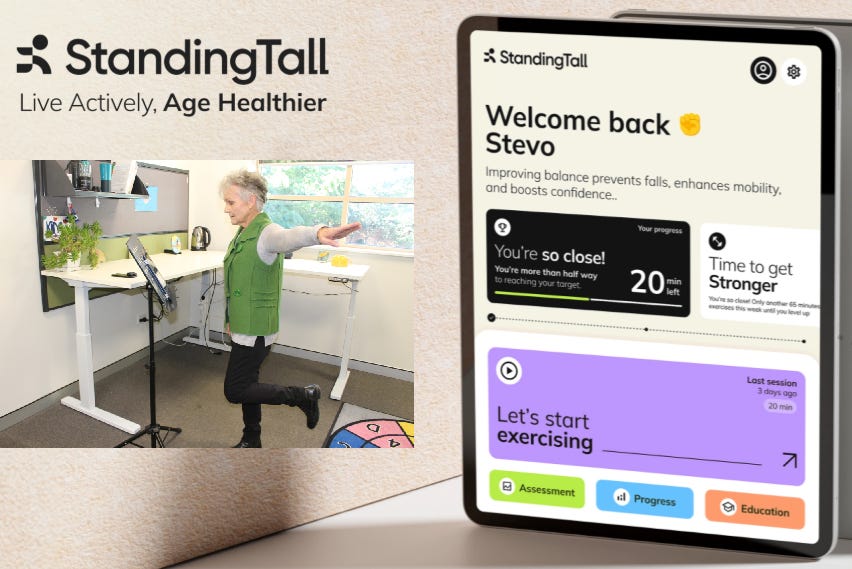
Falls are not an inevitable consequence of getting older, yet the fear of losing stability can quietly reshape how active a life a senior leads. As muscle tone diminishes and joint flexibility decreases with age, natural equilibrium becomes harder to maintain, and confidence in movement erodes alongside it. Many older adults respond by pulling back from daily activities and settling into a more sedentary routine that feels safer but gradually worsens. That self-imposed stillness accelerates the very muscle loss and balance decline it was meant to protect against, deepening the risk of a serious fall rather than reducing it. For both seniors striving to protect their independence and caregivers seeking peace of mind, breaking this cycle requires an approach that addresses the roots of coordination and balance.
The StandingTall program was developed specifically to interrupt that cycle, using a tablet-based application to deliver a personalized, self-managed balance and strength program directly into a user’s home. The product of more than a decade of research at Neuroscience Research Australia (NeuRA) and UNSW Sydney, the app draws on a library of close to 1,000 progressive exercises targeting lower-body strength, ankle flexibility, and balance control. An initial stability assessment establishes a starting point, and the program’s algorithms automatically adjust difficulty based on ongoing performance and Weekly Check-In data, so the training remains appropriately challenging without becoming unsafe. Clear visual demonstrations and synchronized audio instructions guide each session, eliminating the need for wearable sensors, tracking cameras, or any equipment beyond a sturdy chair and common household items.
StandingTall is designed to fit within an existing daily routine rather than displace it, with research supporting roughly two hours of balance training per week (approximately 20 minutes per day) as the threshold for meaningful fall-risk reduction. The app functions fully offline once downloaded, a practical advantage for seniors in areas with unreliable internet access, and any unsynced progress uploads automatically when connectivity returns. Healthcare providers and family caregivers can monitor activity, compliance, and balance improvements using a dedicated dashboard and without needing to be present. A Foundations pathway is available for users transitioning from seated to standing exercises, and the program can also be adapted for those who use walking aids.
The evidence behind StandingTall is as compelling as the program itself is well-designed. A large-scale randomized controlled trial published in The BMJ found that consistent use reduced fall-related injuries by 20% in lower-risk participants, with benefits persisting for up to two years, and by as much as 42% in higher-risk settings within six months. Separate research confirmed the program is also safe and effective for people living with dementia, a population rarely included in digital health studies. For older adults ready to take an active role in protecting their independence, and for families looking for something they can trust, StandingTall is worth a closer look. The program runs on an Apple iPad or Android tablet, and a free 30-day trial is available through the App Store or Google Play, with individual, provider, and organizational subscription options for those ready to go further.
https://standingtall.net.au/
Tags: #standingtall, #fallprevention, #balance, #balancetraining, #balanceexercises, #fallrisk, #mobilityhealth, #healthyaging