
MyoPro Powered Orthosis
Restoring Arm Movement After Stroke

A sudden loss of arm function following a neurological injury, such as a stroke or a brachial plexus injury, creates a significant barrier to independent living. Stroke survivors understand this reality intimately; according to the American Stroke Association, up to 80 percent experience persistent upper limb symptoms or paralysis in the affected arm. When a dominant hand or arm can no longer assist with everyday routines, fundamental tasks become exhausting obstacles. The inability to prepare a meal, manage medications, or dress without assistance forces a heavy reliance on family members and professional caregivers, a loss that reaches beyond logistics into emotional well-being and personal dignity. Regaining even a fraction of upper-extremity mobility can drastically alter a person’s trajectory, shifting the focus from dependence to self-sufficiency.
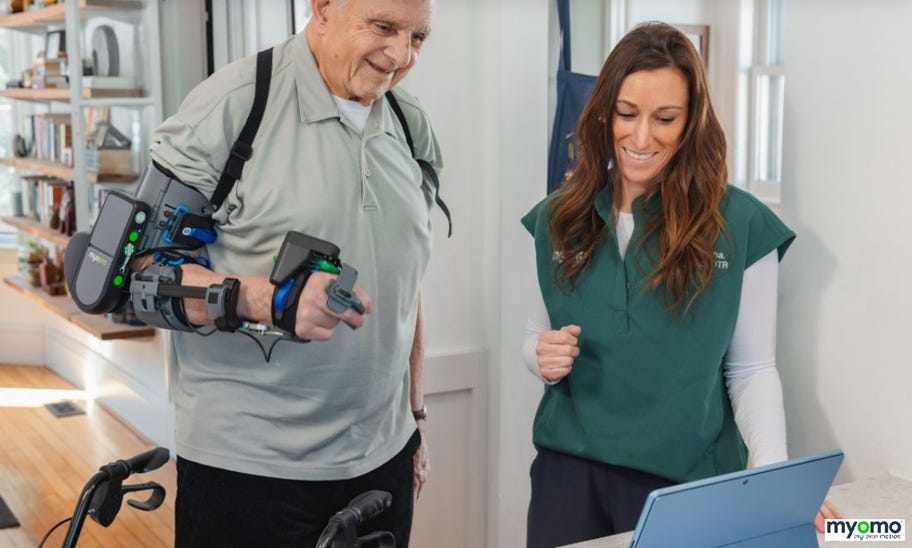
The MyoPro® powered upper limb orthosis by Myomo offers a distinctive approach to this widespread challenge. Originally developed at the Massachusetts Institute of Technology in collaboration with Harvard Medical School, this device is designed to amplify the user’s intent. While most orthotic devices support a weak limb or provide passive structural bracing, the MyoPro is among the few wearable myoelectric devices designed to help restore function for those who still have their arms and hands but can’t yet use them. The device reads faint myoelectric signals from the skin’s surface and is entirely noninvasive, requiring no surgical implants; once the sensors detect the user’s attempt to move, small motors activate to assist the wrist, elbow, and hand. Because it uses the individual’s own neural signals, the user remains in complete control of movement without experiencing any uncomfortable electrical shocks or stimulation, essentially acting as power steering for a weakened arm.
Adapting to this technology requires professional fitting and dedicated practice. Because the device relies on detecting the user’s own muscle signal, it’s best suited to those with some residual muscle activity rather than complete paralysis, a distinction a clinician determines during the fitting process. Once fitted, users strap the custom-fabricated brace onto their affected arm and begin initiating movements they previously struggled to complete: drinking from a cup, opening doors, carrying lightweight objects. Caregivers often notice a decrease in their physical workload as users reclaim the ability to manage personal hygiene and engage in hobbies. Regular use can also aid ongoing rehabilitation, since actively moving the limb encourages muscle reeducation and increases range of motion over time. The system represents a significant financial investment, though the Centers for Medicare and Medicaid Services classified it under the brace benefit category effective January 2024, establishing a lump sum reimbursement pathway under HCPCS codes L8701 and L8702 for eligible Medicare Part B beneficiaries.
Restoring voluntary movement to a paralyzed arm is a profound step toward sustainable independence. The ability to perform basic daily activities without waiting for assistance restores a critical sense of agency and confidence, and that shift ripples outward to the people around them. A spouse who once managed every meal and every button can step back into a supporting role rather than a constant one, and adult children coordinating care from a distance gain some reassurance that a parent can manage more of the day unaided. For the user, the change is less about the tasks themselves and more about choosing when and how to do them. As wearable robotics become more integrated into residential settings, individuals facing significant neurological setbacks gain viable options for maintaining their quality of life at home, where independence can keep pace with recovery.
https://myomo.com/
Tags: #myopro, #myomo, #upperlimborthosis, #strokerecovery, #armparalysis, #assistivetechnology, #wearablerobotics